Description
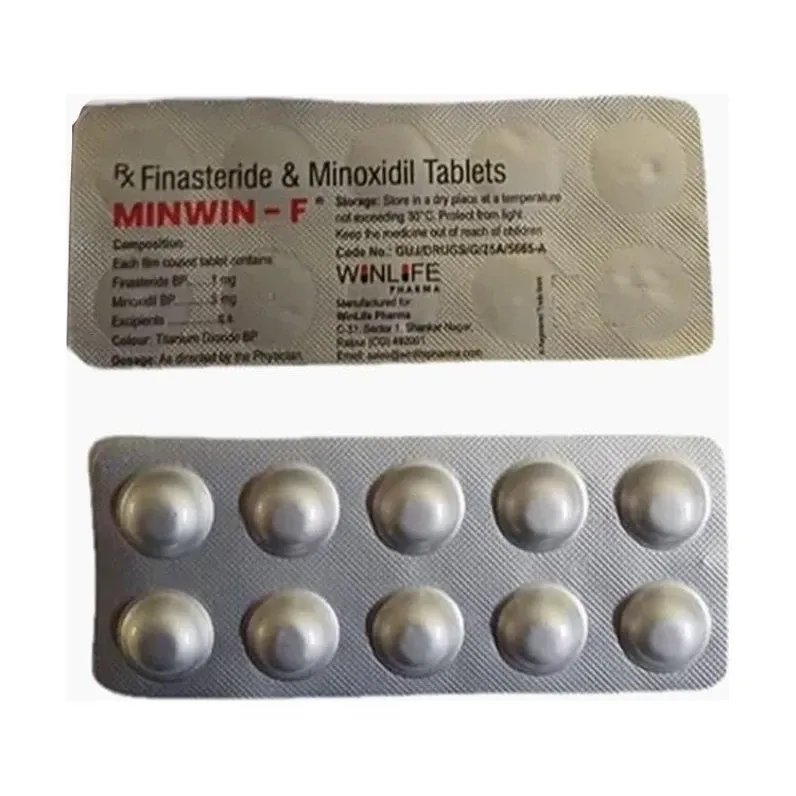
Minwin f-tab
Minwin f-tab is presented as an oral combination product containing finasteride 5 mg and minoxidil 1 mg. The finasteride component is a well-established medicine for male pattern hair loss, while oral minoxidil is an antihypertensive medicine whose use in hair-loss treatment is not an established labelled indication. Because this exact fixed-dose combination was not verified in official regulatory sources, the summary below describes the known properties of the two active ingredients and the limits of the available evidence.
Active Ingredient and Medicine Class
Finasteride is a 5-alpha-reductase inhibitor. It reduces the conversion of testosterone to dihydrotestosterone, the androgen that plays a central role in androgenetic alopecia.
Minoxidil is a peripheral vasodilator and antihypertensive medicine. In hair-loss research, minoxidil is associated with stimulation of hair growth, although the established oral tablet product is approved for hypertension rather than alopecia.
Established Medical Uses
Finasteride tablets are indicated for the treatment of male pattern hair loss (androgenetic alopecia) in men only. Regulatory information notes that benefit may take several months and that stopping treatment can lead to reversal of effect.
Oral minoxidil tablets are indicated for severe hypertension that is symptomatic or associated with target organ damage and not adequately controlled by other antihypertensive medicines. This is a different medical use from hair-loss management.
For the specific finasteride-plus-minoxidil oral combination, established approval for androgenetic alopecia could not be confirmed from the official sources reviewed.
How It Works
Finasteride lowers scalp and circulating dihydrotestosterone by blocking the enzyme that produces it. This can slow the miniaturisation of hair follicles seen in androgenetic alopecia and may allow some follicles to produce thicker hair over time.
Minoxidil’s antihypertensive action involves relaxing blood vessels. The exact mechanism by which minoxidil may support hair growth is not fully defined, but it is thought to prolong the growth phase of the hair cycle and encourage follicular activity.
Important Safety Information
Finasteride is contraindicated in pregnancy and should not be used by women for this indication. Exposure of a pregnant person to broken or crushed tablets should be avoided. Finasteride may also affect PSA blood test interpretation. Regulatory authorities also warn about possible mood changes, including depression and suicidal thoughts, and about sexual adverse effects such as decreased libido and erectile dysfunction.
Oral minoxidil tablets carry important safety concerns, including the risk of serious cardiovascular adverse effects. Official prescribing information warns about pericardial effusion, possible tamponade, exacerbation of angina, and marked blood-pressure lowering. Minoxidil tablets are also contraindicated in pheochromocytoma and in people with hypersensitivity to the product.
Because this is an oral combination, clinically significant safety considerations may include additive monitoring concerns related to finasteride’s reproductive and psychiatric warnings and minoxidil’s cardiovascular risks.
Possible Side Effects
Commonly reported finasteride adverse effects include decreased libido, erectile dysfunction, and ejaculation disorders. Regulatory reviews also recognise mood-related adverse effects in some patients.
Minoxidil tablets may cause fluid retention, rapid heartbeat, changes in blood pressure, and other cardiovascular effects. More serious reactions can include pericardial effusion. Because oral minoxidil is a potent antihypertensive medicine, its adverse-effect profile is more medically significant than that of topical hair-loss products.
Scientific Evidence
Human studies support finasteride as an effective treatment for male pattern hair loss. Published comparative trials have also shown that combining oral finasteride with topical minoxidil can improve hair outcomes more than monotherapy in some settings. However, these studies do not establish efficacy or safety for this exact oral fixed-dose combination.
Research on oral minoxidil for hair loss has increased in recent years, but the evidence base remains smaller than for established finasteride treatment, and the oral tablet formulation retains its hypertension-focused safety warnings. Overall, evidence for a combined oral finasteride-plus-minoxidil hair-loss product remains limited and should be interpreted cautiously.
Medical Information Notice
This page is an educational summary based on sources available at the time of review. It does not replace the official patient leaflet, product label, or individual assessment by a qualified healthcare professional.
Medical Sources
- U.S. Food and Drug Administration / DailyMed. Finasteride tablets, prescribing information. View official prescribing information
- U.S. Food and Drug Administration / DailyMed. Minoxidil tablets, prescribing information. View official prescribing information
- European Medicines Agency. Finasteride- and dutasteride-containing medicinal products referral. View regulatory review
- Ercan Arca et al. An open, randomized, comparative study of oral finasteride and 5% topical minoxidil in male androgenetic alopecia. Dermatology, 2004. View scientific article
- Ruiming Hu et al. Combined treatment with oral finasteride and topical minoxidil in male androgenetic alopecia: a randomized and comparative study in Chinese patients. Dermatologic Therapy, 2015. View scientific article